

Nine seasons on the campground loop, I watched maybe two dozen different cots come and go past my host site. Most of what gets written about a camping cot is the same handful of sentences: rated to some number of pounds, folds down small, done. Nobody tells you what actually happens by the third month of owning one, or what the photos on the Amazon listing quietly leave out of frame. I bought the ARAER Camping Cot, rated to 450 pounds, at the start of last season, and this is the review I wish someone had written before I set mine up on a night that dropped into the forties.
I already put together the frame-by-frame breakdown, the leg welds, the fabric deck, how it held up night after night through a full season, in my long-term review of the ARAER cot. Read that one if you want the play-by-play. What follows here is different. It's the stuff that only shows up after the newness wears off, the return complaints I've overheard from other campers on my loop over the years, and the one problem almost nobody warns a first-time cot buyer about before their first cold night out.
The Quick Verdict
A solidly built cot for the money, but the listing photos and the spec sheet both leave out the parts that actually decide whether you sleep well on it.
Amazon Check Today's Price →Want the version of the review the spec sheet doesn't give you?
This is the honest breakdown of the ARAER Camping Cot, including the cold-night problem most listings never mention. Check today's price on Amazon and read on for what actually matters before your next trip.
Amazon Check Today's Price on Amazon →How I've Actually Used It
My own ARAER cot has spent a full season inside my 22-foot travel trailer as a guest bed, plus more nights than I can count set up in a tent when I helped cover for other hosts on adjoining loops. But the more useful part of this review isn't my one cot, it's what I heard walking forty occupied campsites a night for nine seasons. Campers talk to their host, especially the ones with a problem, and a cot that isn't working right comes up constantly, usually around the third or fourth morning of a trip, not the first.
That timing matters. A cot almost never fails a camper on night one. It fails them on night three, when the excitement of a new piece of gear has worn off and they're just trying to get decent sleep before an early hike or a long drive home. That's the window this review is written for, the part after the unboxing photos stop mattering and the gear has to just work.
What the Listing Photos Don't Show You
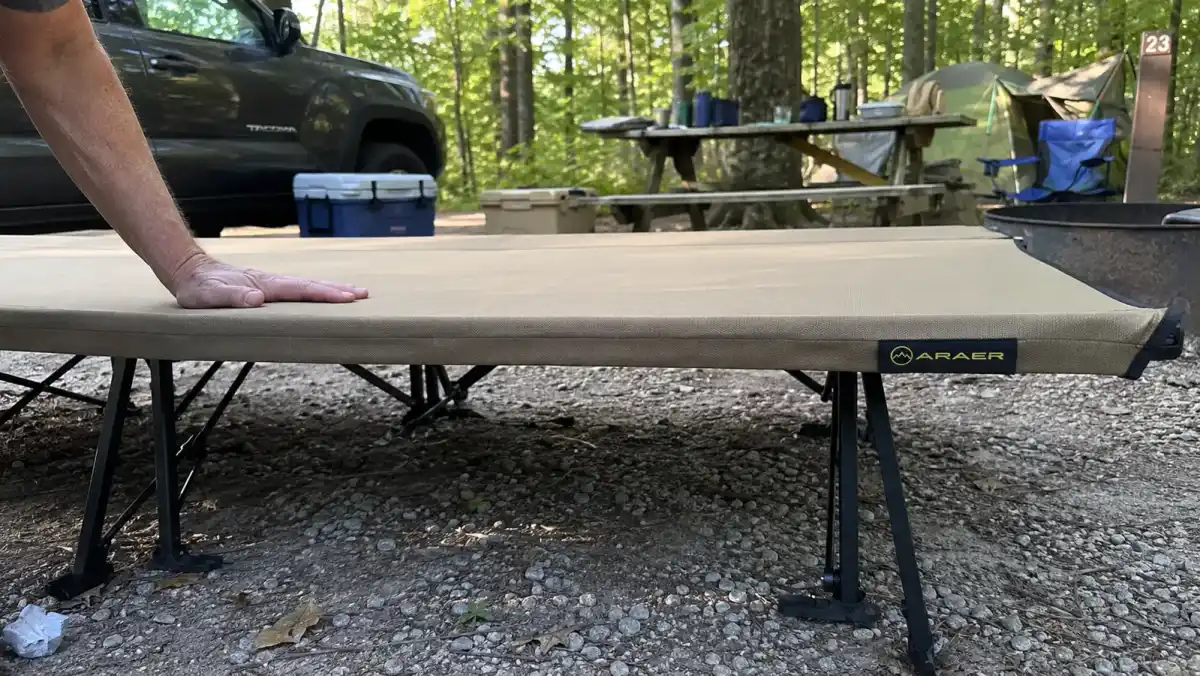
Amazon product photos are shot to sell a cot, not to show you what it's like to lie on one, and there are three things the ARAER listing photos genuinely leave out. The first is height. In the photos the cot looks like it sits close to the ground, almost like a cushioned mat. In real life it sits about 15 to 17 inches up on its frame, which is closer to a low bed than a floor mat. That's a feature for most people, easier to get up off of, but it changes how the cot fits inside a tent with a low rain fly, and nobody shows you that clearance problem in a photo.
The second thing the photos hide is the center crossbar. Every folding cot like this one has a support bar running under the fabric deck to keep the frame rigid, and depending on how you lie and how firm your build is, you can feel a faint ridge where that bar sits. It's not a dealbreaker, most people stop noticing it after a night or two, but the marketing photos are shot from angles that never let you see the frame underneath the fabric, so you have no way to judge it before you buy.
The third thing, and the one that matters most, is what's underneath the cot entirely. Every product photo shows the cot from the side or from above, fabric taut, looking finished. None of them show you the open air gap between that fabric and the ground, which brings me to the actual discovery that changed how I recommend this cot to anyone.
The Month Three Discovery: Why a Cot Sleeps Colder Than the Ground
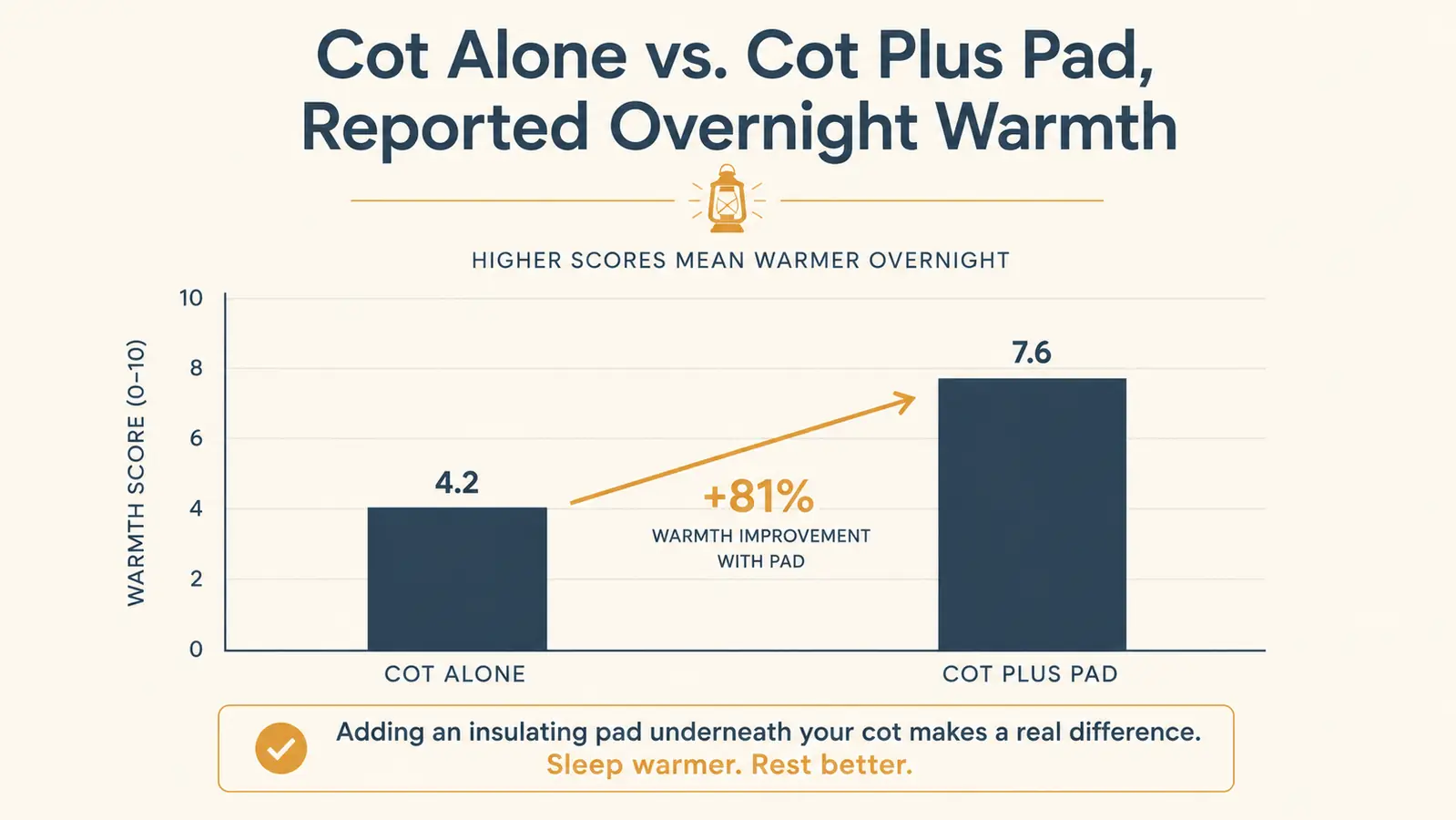
Here is the thing nobody tells a first-time cot buyer, and it took me watching it happen to other campers, not just reading about it, to really believe it. A cot puts open air underneath your body instead of solid ground. On a mild night that's an advantage, better airflow, no cold dampness soaking up from the dirt. But on a night that drops into the forties, that same open air becomes a problem, because cold air moves and circulates underneath a cot in a way that solid, insulated ground never does. Sleeping bags are rated assuming some amount of ground contact and ground warmth working in your favor. Take that ground away and put moving air there instead, and a bag that would have kept you plenty warm on the dirt can leave you shivering on a cot.
I watched this happen more than once on my loop. A family would set up a cot for the first time on a cool fall weekend, sleeping bag rated well below freezing, and still show up at my truck the next morning asking why they'd been cold all night. It's not intuitive. Most people assume being off the ground is strictly an upgrade, and in most ways it is, fewer bugs, no rocks under your hip, easier on your back. But warmth is the one place a cot can actually work against you compared to sleeping directly on the ground with a good pad.
The fix is simple once you know it's coming, and it's the one thing I wish the ARAER listing mentioned outright instead of leaving it for buyers to discover the hard way. Put an insulating layer between you and the cot fabric, a foam sleeping pad, a self-inflating pad with a real R-value, or even a couple of wool blankets folded under your sleeping bag. That layer breaks up the cold air moving underneath you and it makes a bigger difference on a cool night than almost any other single change you can make to your setup. The cot itself isn't the problem. Sleeping on it with nothing underneath you is.
The Specs That Turn Out Not to Matter
The number everyone fixates on with this cot is the 450 pound weight rating, and after watching a lot of cots across a lot of campsites, I'll say plainly it matters far less than people assume once you're above roughly 250 pounds. Most campers never get near the rated limit, and the number that actually decides your comfort is width and how the fabric distributes pressure, not the ceiling of the frame. Two campers of similar weight can have very different nights on the same cot depending on whether they sleep on their back or their side, because a side sleeper concentrates weight over a narrower strip of fabric and feels that center crossbar more than a back sleeper does.
Packed size gets a lot of attention in reviews too, and it also matters less than people expect. The ARAER cot folds down to roughly the size of a beach umbrella bag, and whether that's a problem for you has almost nothing to do with the cot and everything to do with your vehicle. I never once heard a camper complain about pack size when they had truck bed space to spare, and I heard about it constantly from campers working out of a compact hatchback with two kids' worth of gear already crammed in the back.
Who Actually Returns This Cot, and Why
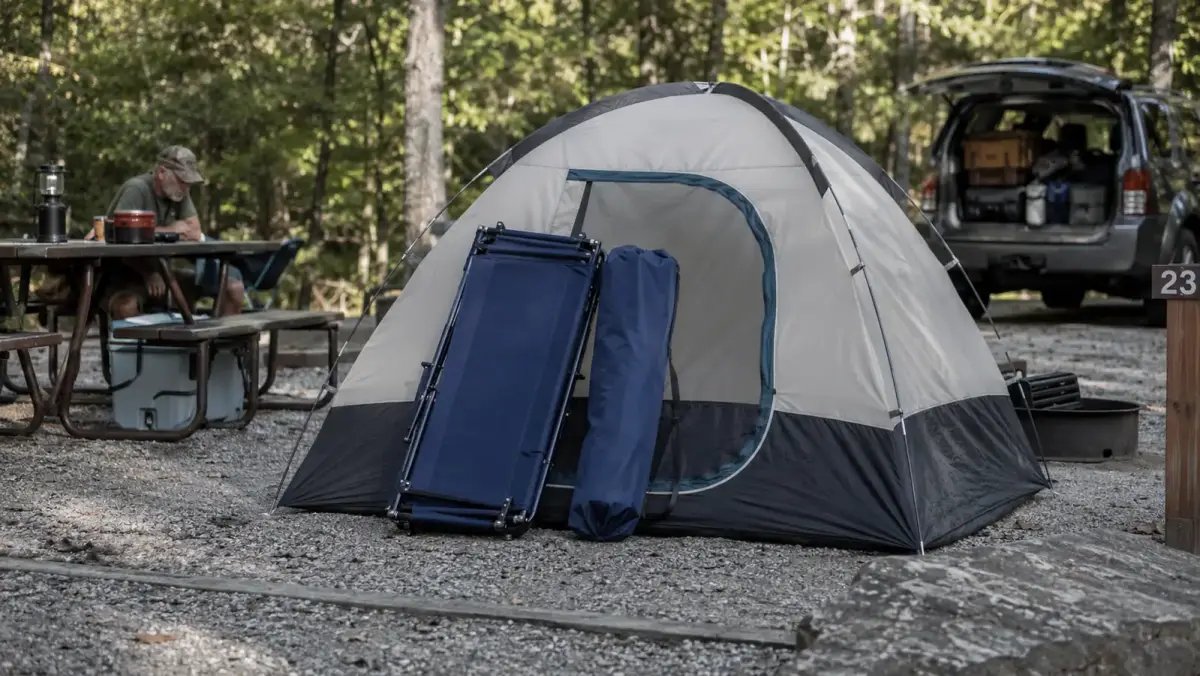
I don't have Amazon's return data, but I've heard the same handful of complaints often enough across enough different campers that I trust the pattern. The most common one is the cold-underneath problem I already covered, someone buys a cot expecting it to sleep at least as warm as the ground and gets caught off guard on their first cool night, then blames the cot instead of their setup. The second most common complaint is fit. A cot this size, close to 75 inches long and around 30 inches wide when set up, does not fit inside a lot of compact two-person backpacking-style tents that campers bring for car camping anyway. It needs floor space, and buyers who don't measure their tent interior before ordering are the ones most likely to end up disappointed.
The third complaint I've heard, less often but consistently, is noise. The frame legs have a metal-on-metal creak when you shift your weight, especially in the first few uses before things settle in. It never bothered me enough to matter, but a light sleeper in a quiet tent notices it, and I've had more than one camper mention it specifically. None of these three things are defects. They're mismatches between what a buyer expected and what a folding cot actually delivers, which is exactly the kind of thing an honest review should say out loud instead of a five-star headline.
The Small Annoyances That Show Up After a Few Trips
Beyond the big three complaints, there's a shorter list of small things that only show up once a cot has actually been used a handful of times, and they're worth knowing before your first trip rather than your fourth. The leg locking pins, the ones that hold the frame open once you've stood it up, loosen slightly with repeated folding and unfolding. It's not a safety issue, the cot doesn't collapse, but by trip five or six you'll notice you need to press a little harder to feel each pin seat fully, and skipping that check is how a leg ends up wobbling mid-trip instead of locking flush.
The carry bag is another spot where the newness wears off fast. It fits the folded cot fine on day one, snug but workable. After a season of stuffing it back in at the end of a trip, usually in the dark, usually in a hurry, the zipper starts fighting you a little more each time. I've never seen one fail outright, but I've watched more than one camper give up and just bungee the folded cot to a roof rack instead of wrestling with the bag. None of this changes my verdict on the cot itself, it's simply the part of ownership that never makes it into a first-impression review because it hasn't happened yet.
What I Liked
- Frame genuinely holds up to the 450 pound rating without flexing or creaking under heavier campers over a season of use
- Sits high enough off the ground that getting in and out is easier on knees and backs than a ground pad
- Folds into a carry bag that's manageable for one person to load and unload from a truck bed
- Keeps you off cold, damp ground and away from crawling bugs better than any mat on the tent floor
- Setup is straightforward enough to do solo, even in low light, once you've done it once or twice
Where It Falls Short
- Sleeps noticeably colder than the ground on a night in the forties or below unless you add a pad underneath you
- Center crossbar is faintly noticeable to side sleepers, especially in the first few nights
- At roughly 75 by 30 inches, it does not fit inside a lot of compact two-person tents used for car camping
- Metal frame legs creak with weight shifts, more noticeable to light sleepers
- No pad or insulation included, which is the single biggest gap between what buyers expect and what actually ships
A cot doesn't fail you on the first night. It fails you on the third, once the excitement wears off and you're just trying to stay warm.
Who This Is For
This cot is a strong fit for anyone who already knows to pack a pad underneath it, or who mostly camps in seasons where nights stay above 55 degrees and cold-underneath sleeping is a non-issue. It's also a good match for anyone with a back or knee problem that makes ground sleeping rough, since getting up off a cot at 15 to 17 inches high is a completely different experience than pushing up from a mat on the tent floor. If you camp out of a truck bed or a larger tent where the footprint isn't a problem, and you go in expecting to add a layer of insulation on cooler trips, this is a well-built cot for a reasonable current price on Amazon.
I'd skip it if you camp exclusively in a compact tent where floor space is already tight, since the size that makes this cot comfortable is the same size that crowds out a small tent. I'd also skip it if you're buying for shoulder-season or cold-weather trips and aren't willing to pack a pad, because sleeping on bare cot fabric on a cold night is the single most common complaint I've heard from other campers, and it's an easy problem to avoid but a miserable one to discover at 2 a.m. If you're still weighing a cot against just bringing a good air mattress instead, I put together a side-by-side comparison of a camping cot against a standard air mattress that walks through the tradeoffs in more detail.
Know what you're actually getting before your next trip
The ARAER Camping Cot holds up well once you know to pack a pad for cold nights. Check today's price on Amazon and go in with the full picture, not just the listing photos.
Amazon Check Today's Price on Amazon →