

If you're choosing between a camping cot and an air mattress for your next trip, here's the short answer from someone who watched hundreds of both succeed and fail at a real campground: get the cot. I spent nine seasons as a seasonal campground host at an Ozarks state park in northern Arkansas, walking the loop at dusk and checking roughly forty occupied campsites a night from April to October, and I watched more punctured, half-flat air mattresses than I can count. The ARAER Camping Cot is the one I'd point a first-time car camper toward if a good night's sleep matters more to them than the lowest price at the store.
That doesn't mean the air mattress is a bad product, and I'm not going to pretend it is just because I'm recommending a cot. I've slept on both more nights than I'd like to admit, sometimes because my own cot was loaned out to a camper whose gear had just failed on them, and a good air mattress on a calm, dry night is genuinely comfortable, plush in a way a cot's tight fabric never quite matches. The real question isn't which one wins on a spec sheet, it's which one survives your actual campsite: the gravel pad, the sloped tent floor, the dog that wants up on the bed, the cold snap that shows up in October whether you planned for it or not. That's what this comparison is built around.
I've thought about this comparison more than most, because I watched it play out night after night for nine seasons in the same forty campsites. Both sleep systems showed up on my loop constantly, and I got to see them fail in slow motion over a whole season rather than judging either one off a single weekend trip. A cot that's fine on night one but starts squeaking by night four tells a different story than a cot that's still solid in October, and the same goes for an air mattress that's firm at 9 p.m. and half flat by 3 a.m. That long view is the only reason I trust my own opinion here.
| Category | ARAER Camping Cot | Air Mattress |
|---|---|---|
| Weight capacity | 450 lbs, and I've watched heavier campers use it without the frame flexing | Roughly 300 lbs on a standard twin-size air mattress before the seams start to strain |
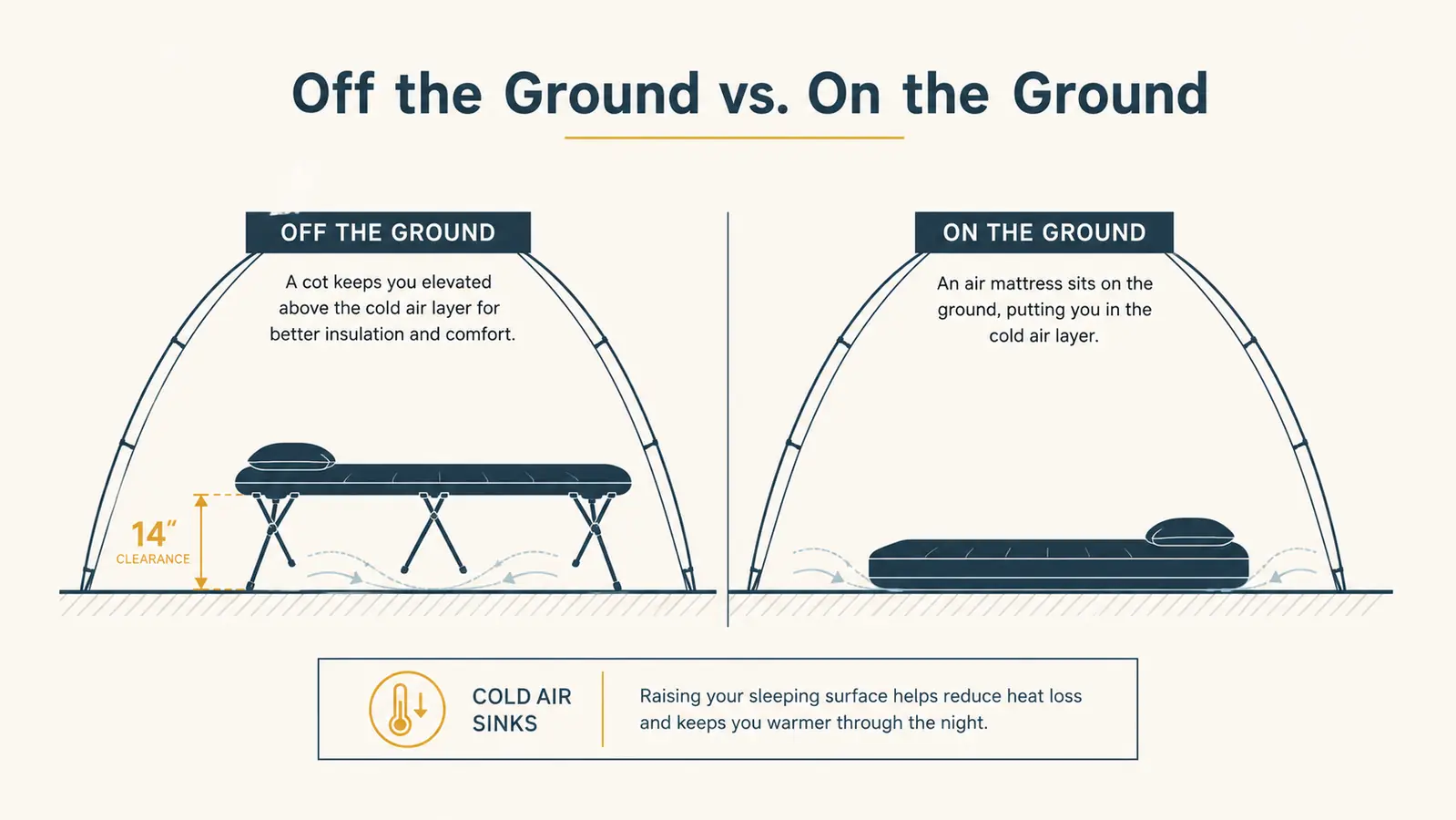
| Off-ground clearance | About 14 inches above the tent floor | Zero, you're lying directly on the ground with a few inches of air underneath you |
| Cold-night warmth | Airflow underneath keeps cold from pooling against you, though you still need a pad or a warm bag | Cold ground pulls heat straight through the air pocket, the single most common complaint I heard on cold nights |
| Puncture risk | None, it's a steel frame with heavy fabric, nothing to pop | Real risk from gravel, pine cones, and tent zippers, I patched more than a few for campers who forgot a footprint |
| Setup time | Unfolds and locks in well under a minute, no pump or tools | Needs a pump, foot or battery-powered, and takes several minutes to fully inflate |
| Packed size | Folds into a carry bag roughly the size of a beach chair, about 40 inches long | Packs down smaller once fully deflated, an advantage if trunk space is tight |
| Under-bed storage | Enough clearance underneath to slide a duffel bag or boots out of the walking path | None, whatever's in the tent stays on the floor around it |
| Comfort feel | Firm, supportive fabric that some side sleepers find less plush than they'd like at first | Soft, cushioned surface that feels closer to a real mattress when it's properly inflated |
| Upfront cost | Costs more than a basic air mattress, current price varies | Usually the cheaper option upfront, current price varies |
Where the ARAER Camping Cot Wins
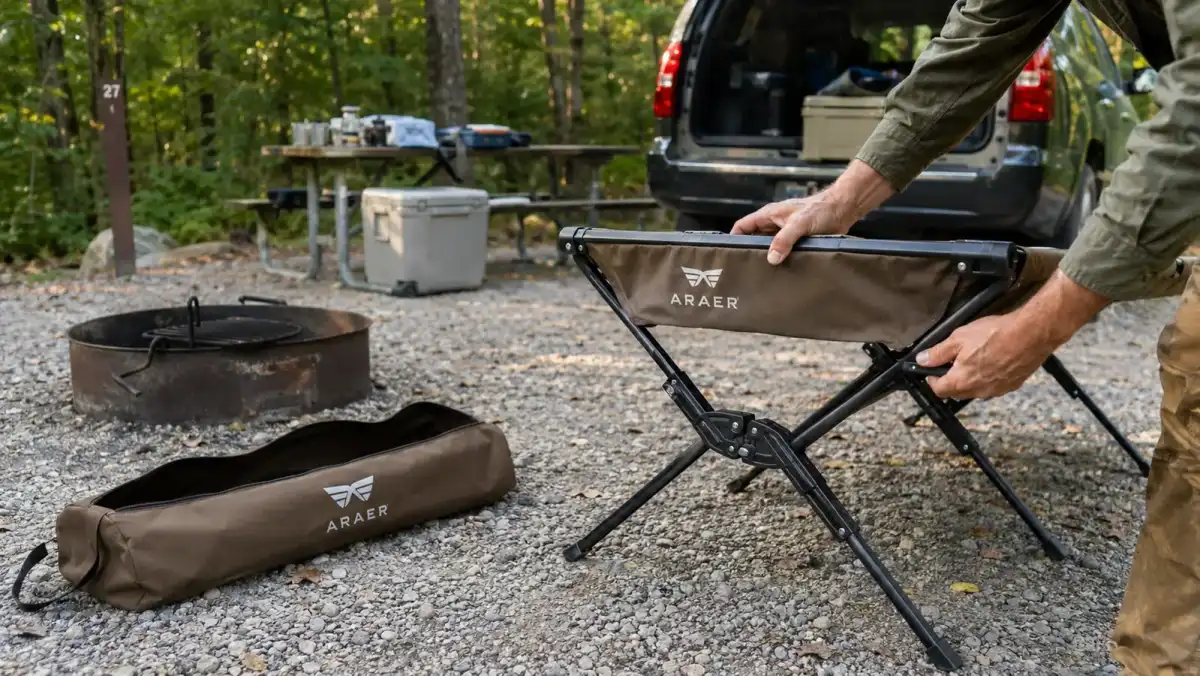
The biggest reason I steer campers toward the ARAER Camping Cot is the 450-pound weight rating, and after nine seasons I don't take a number like that on faith, I watch it. I've seen this exact cot under bigger campers who told me they'd bent the frame on a cheaper model the year before, and it held without a wobble. The steel legs sit wide enough that it doesn't rock on an uneven gravel pad, which matters more than people expect when you're setting up on a mix of packed dirt and rock. A cot that shifts every time someone rolls over is a cot nobody sleeps well on, and I never got that complaint about this one, not from me and not from the two neighboring campers who bought it after watching mine hold up all season.
Sleeping off the ground is the other half of the argument, and it's the part people underestimate until their first cold night out. Cold air sinks and pools right at ground level, and an air mattress puts you inside that layer with nothing but a few inches of air between you and it. The ARAER cot lifts you roughly 14 inches up, clear of that cold pocket, and combined with even a basic sleeping bag it made a real difference on the chilly October mornings near the end of my camping season. I also liked having open space underneath the frame to slide my boots and a duffel bag out of the walking path in a small tent, which an air mattress lying flat across the floor just doesn't give you.
The last thing that sold me over a season of watching this cot get used was how fast it goes up and down. No pump, no valve, no standing there counting strokes while everyone else sets up around you. It unfolds and locks in under a minute, which matters at the end of a long drive when everyone just wants to eat and get horizontal. I also never once patched a puncture on this cot, not mine and not the ones I watched at other campsites over the years. Punctured air mattresses were one of the most common complaints I fielded on my nightly walks, usually from a rock or a stray pine cone nobody noticed until it woke them up at 2 a.m.
There's also a durability difference that only shows up over a full season, and it's the kind of thing a first-trip review can't tell you. I watched this cot's carry bag get thrown in the back of a truck bed alongside firewood, coolers, and a tackle box, week after week, and the frame never developed the kind of play in the joints that I've seen on cheaper cots after a summer of that treatment. An air mattress, by comparison, is a consumable in my experience. Most families I checked in on replaced theirs at least once a season, whether from a slow leak they never found or a seam that finally gave out.
Where the Air Mattress Wins
I'd be lying if I told you the air mattress has nothing going for it. Comfort is the real one. A good air mattress, properly inflated, has a plush give that a cot's taut fabric can't match, and if you're used to a real mattress at home, the first night on any cot can feel firmer than you'd like. Side sleepers notice it especially. I've had campers tell me they slept better on an air mattress the first night out, even if that opinion changed by night three or four once their hip started reminding them the ground was still right underneath everything.
Packed size is the other honest advantage, once the air mattress is fully deflated. A folded air mattress with the pump packed separately can tuck into a smaller space than a cot's carry bag, which matters if you're working with a compact car and every cubic foot of trunk space is already claimed by a cooler and a tent. It's also usually the cheaper option upfront, and if you only camp once or twice a year, that lower cost is a fair consideration. Not everyone needs a piece of gear built to survive forty nights in a season.
It's also just familiar. Most people have slept on an air mattress at some point, in a guest room or on a friend's living room floor, so there's no learning curve and nothing to figure out beyond finding the pump and a working outlet or batteries. For a family tent with a few kids sharing the floor, an air mattress can also let you fit more sleeping surface into the same footprint, since you can push a couple of them edge to edge in a way you can't stack cots side by side without losing walking room.
I'll also say the height works both ways. A cot's 14 inches off the ground can feel like a lot to a small kid or an older camper climbing in and out at night, especially in a dark tent with no light on. An air mattress sits low enough that getting in and out is a non-issue for almost anyone, and I've heard that specific complaint from parents whose kids kept rolling off a cot in their sleep before switching back to a low mattress on the ground.
Tired of waking up on a half-flat mattress at 3 a.m.?
The ARAER Camping Cot skips the pump, the puncture risk, and the cold ground entirely, and it's rated to hold 450 pounds. Check today's price on Amazon before your next trip.
Amazon Check Today's Price on Amazon →
Who Should Buy Which
If you camp more than a couple times a season, drive to your site instead of carrying gear on your back, and you're tired of patching leaks or shivering awake before sunrise, get the cot. That's true whether you're car camping solo, splitting a tent with your kids, or hauling gear the way I did for years out of the bed of my 2011 Toyota Tacoma. It's also the better call for anyone over about 250 pounds, since a basic air mattress rarely holds up under sustained weight the way this cot's steel frame does. I wrote up a full season-long review of the ARAER cot if you want more detail on how it held up over months of near-daily use at my host site.
The air mattress still makes sense in a few specific cases: a once-a-year trip where cost matters more than comfort, a family tent with young kids who need a low bed to climb into, or a trip where trunk space is genuinely tight and every inch counts. If none of those describe your situation, and you're mostly deciding based on which one actually lets you sleep through a full night, the cot wins that argument almost every time I've watched it play out on my loop. For more on why I stopped recommending ground sleeping altogether, I put together ten reasons a camping cot beats sleeping on the ground.
My own rule of thumb after nine seasons is simple. If you're setting up a tent more than a few nights a year, buy the gear that survives a season, not the gear that survives a weekend. The cot costs more the day you buy it and less every night after that, once you count the air mattress you'll eventually replace, the patch kits, and the mornings you woke up on the ground because a slow leak got you sometime after midnight. That math is why I still recommend it to nearly every car camper who asks me which one to buy.
Ready to actually sleep through the night at camp?
After watching air mattresses fail all over my campground for nine seasons, the ARAER Camping Cot is the one I trust off the ground. Check today's price on Amazon and see if it's in stock for your next trip.
Amazon Check Today's Price on Amazon →