
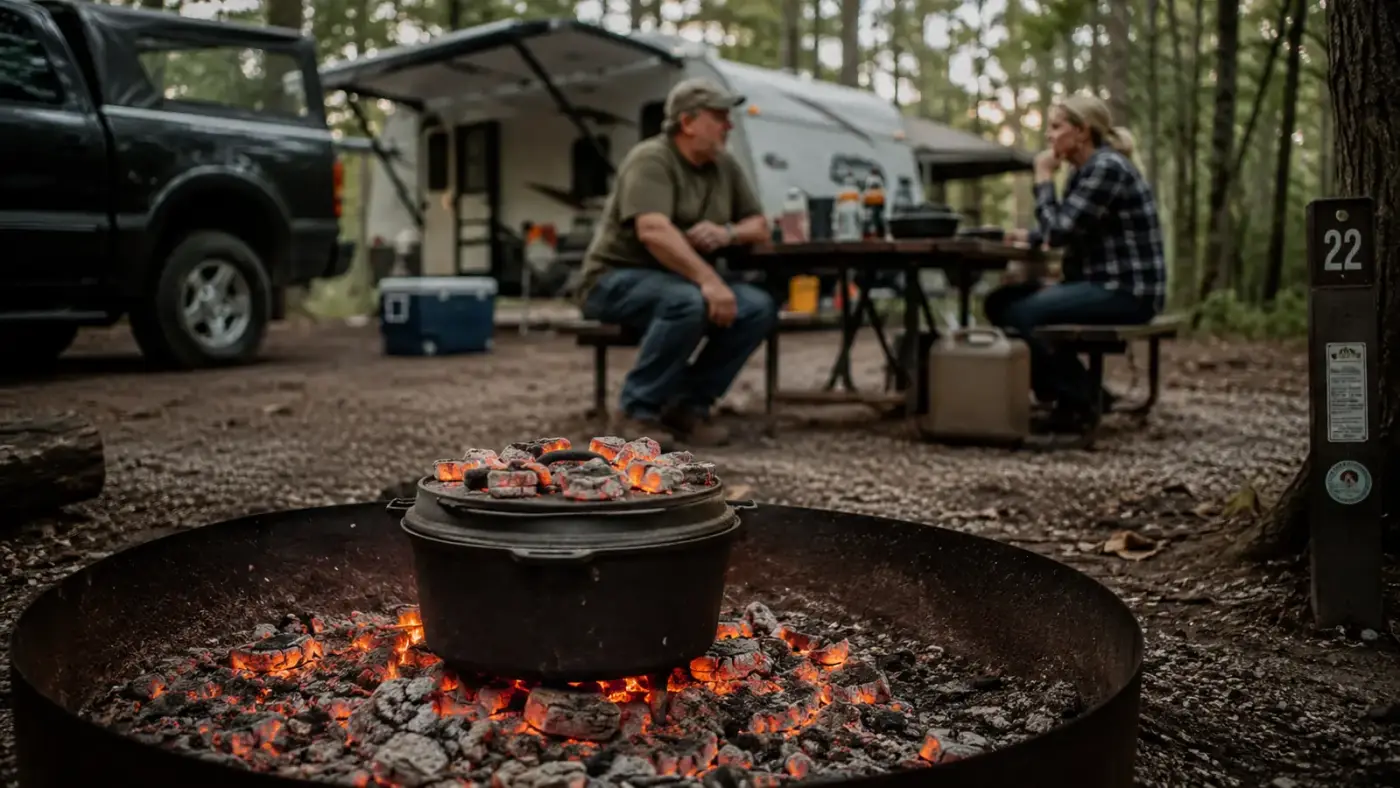
I have watched a lot of camp cooking go wrong from the loop. Nine seasons checking roughly forty occupied campsites a night at an Ozarks state park in northern Arkansas taught me that most camp cooking failures aren't the cook's fault, they're the pot's fault. A thin aluminum pot scorches a chili on one side while the other side stays cold. A cheap enameled pot chips the first time it touches a rock at the edge of a fire ring. So when I finally bought the Lodge Cast Iron Camp Dutch Oven, 6 Quart, I already knew what I was looking for, because I'd watched the same style of oven survive on other people's fire rings for years before I owned one myself.
This is the camp style, not the kitchen style, and that distinction matters more than most first-time buyers realize. It stands on three short legs so it sits directly in a bed of coals instead of on a stovetop, and the lid has a raised flange around the edge that holds a second pile of coals on top without them sliding off. That's what lets you bake a cobbler or a pan of biscuits with heat coming from above and below at the same time, the way a real oven does, using nothing but hardwood coals. A kitchen dutch oven with a domed lid and no legs can't do any of that. This review covers a full season of using the Lodge oven that way, at real fire rings, not a stovetop demo in someone's kitchen.
The Quick Verdict
A genuine lifetime piece of camp cookware if you're willing to learn coal placement and keep it dry between trips. Heavy, unglamorous, and better at almost everything than the gear it replaces.
Amazon Check Today's Price →Tired of scorched dinners and pots that warp over a fire ring?
The Lodge Cast Iron Camp Dutch Oven is built for coals, not a stovetop, with three legs and a flanged lid that holds heat evenly from above and below. Check today's price on Amazon before your next trip.
Amazon Check Today's Price on Amazon →How I've Used It
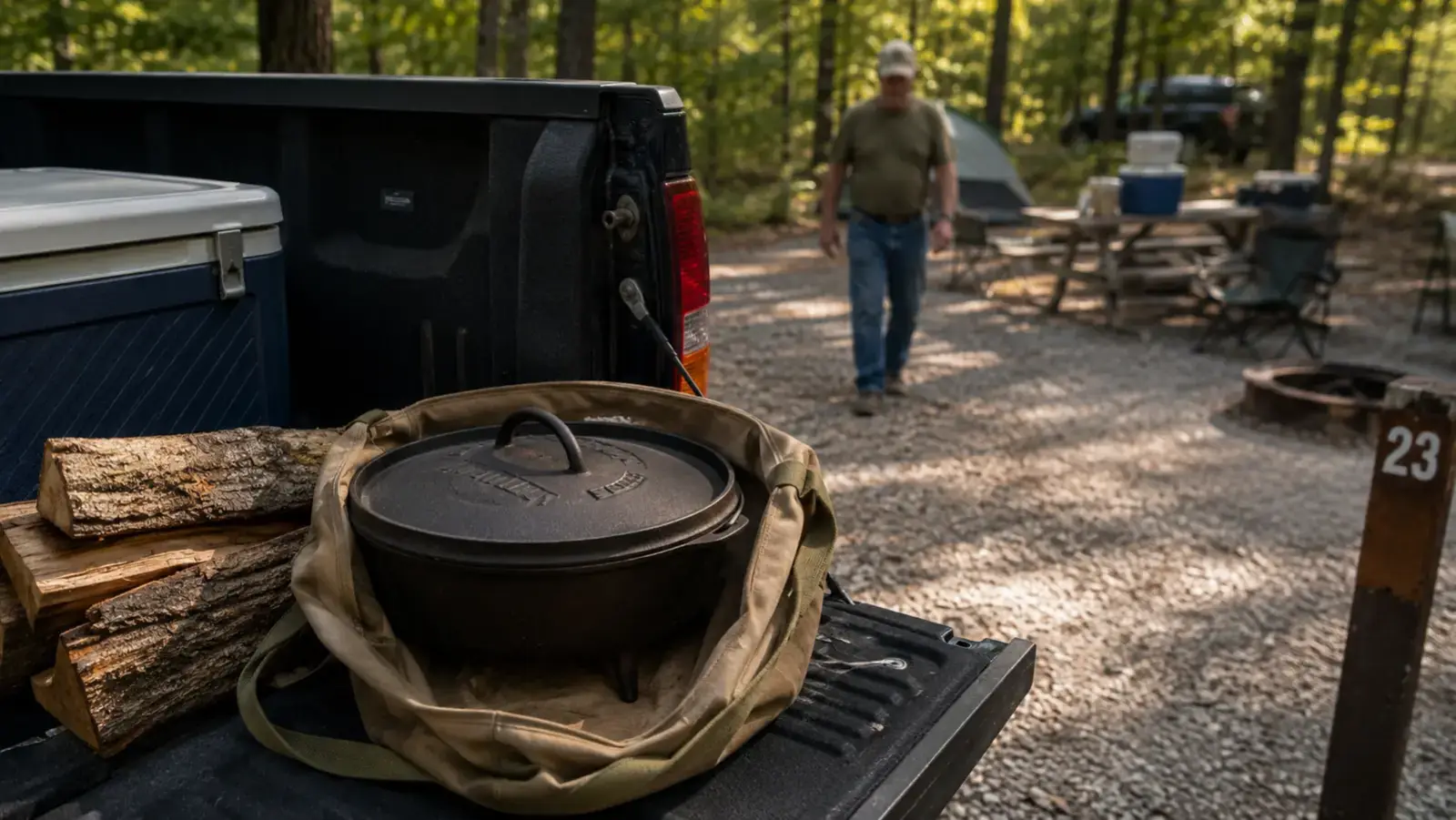
I bought this Lodge dutch oven at the start of a season and used it through the whole run, April to October, living out of my 22-foot travel trailer at the host site on Loop B. It cooked more meals for me that season than my trailer's propane stove did. Chili on cold check-in nights, a pot of biscuits more Sunday mornings than I can count, and a peach cobbler I made often enough that campers on the loop started timing their evening walks around the smell of it. It rode in the bed of my 2011 Toyota Tacoma to two group cookouts I helped host for campers on my loop, and it got loaned out twice to families who wanted to try camp cooking on coals for the first time and didn't own one yet.
Because I walked the loop at dusk and checked roughly forty occupied campsites a night, I also watched other campers use dutch ovens like this one, some the same brand, some cheaper, across a full season and in every kind of weather. I watched one left out uncovered through three days of rain come back rusted at the rim, which is the single most common failure I've seen with cast iron camp cookware, and it isn't the metal's fault. It's a storage problem, not a cooking problem, and I'll get into exactly how to avoid it further down.
I want to be upfront about who this review is for. This is a car camping and campground piece of gear, full stop. It rides in a truck bed or a cargo box, and it gets set up at a site you drove to. Nobody is carrying a 20-pound cast iron oven on their back to a backcountry site, and if that's the kind of camping you do, this review and this product are not for you.
The Legs, the Flanged Lid, and Why the Camp Style Exists
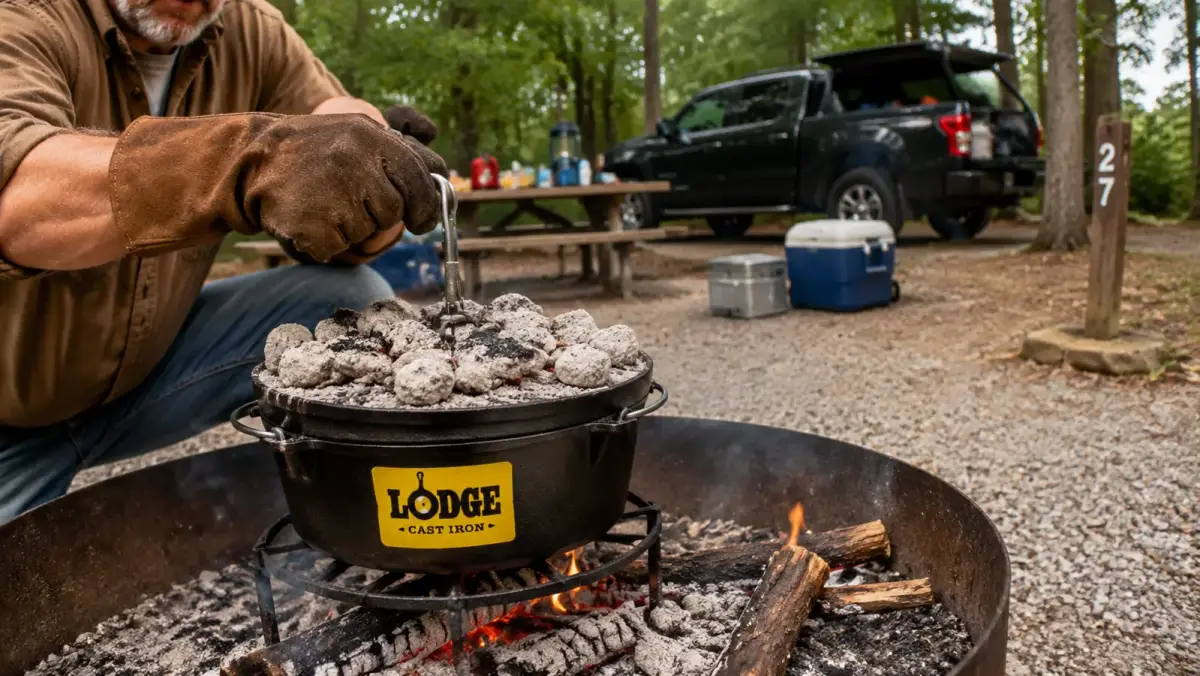
The Lodge name is the same brand people know from kitchen cookware, but this specific piece is built differently on purpose. The three legs lift the body a couple of inches off the ground, which is the whole point: you rake a bed of coals, set the oven down directly in them, and the coals underneath do the work a burner would do on a stove. I watched enough campers set a flat-bottomed pot on top of coals and scorch the bottom black before the middle ever got hot to know this isn't a small design detail, it's the difference between food that cooks evenly and food that burns on one side.
The lid is the other half of the design, and it's easy to miss why it matters until you use one. It has a raised lip around the outer edge, a flange, that keeps a shovelful of coals sitting on top of the lid instead of rolling off into the fire ring. That's what turns this into an actual oven rather than a pot with a lid on it. Heat comes from below through the legs and from above through the coals on the flanged lid, and a cobbler or a pan of cornbread bakes through instead of just heating from one side. I never got that kind of even bake out of a flat kitchen dutch oven balanced on a grate over coals, which is what I used for years before this one.
The lid also doubles as a griddle if you flip it over onto its own legs and set it upside down over coals, which I did more than once for bacon and eggs on a morning I didn't want to dirty a second pan. It's a small thing, but it's the kind of detail you only appreciate after a season of actually cooking outdoors, not reading a spec sheet.
Cooking on Coals for a Full Season
The Lodge oven comes pre-seasoned out of the box, and I used it within the first week without adding much of my own seasoning first, which is more than I can say for some cast iron I've bought over the years. That first-week chili came out with a slightly metallic edge that I've read is normal for a brand-new pre-seasoned pan, and by the third or fourth use that was gone entirely.
What surprised me most was how forgiving it got to be with heat. A thin pot demands constant attention over an open fire, you're pulling it off and putting it back to keep from scorching. This oven holds heat evenly enough in the cast iron walls that once I had a good bed of coals going, I could walk the loop for twenty minutes, come back, and stir a chili that hadn't burned on the bottom. That kind of steady, even heat is the entire reason people put up with the weight of cast iron in the first place, and after a season I understand why campers who cook this way rarely go back to anything else.
Biscuits and cobbler were where the flanged lid earned its keep. I baked biscuits in this oven more Sunday mornings than not for the back half of the season, and they browned on top the same way an indoor oven would, which never happened for me with a flat lid and no coals on top. If you're deciding between this and an enameled version for baking specifically, I put together a full side-by-side comparison against an enameled dutch oven that covers the tradeoffs in more detail than I can fit here.
Weight, Rust, and What It Takes to Keep It Right
This is a heavy piece of gear, and I want to be straight about that before anything else. The bare oven, no lid, no coals, no food, comes in close to 20 pounds. Add the cast iron lid on top of that and you're carrying real weight from the truck bed to the fire ring and back, every single trip. If you're setting up once and leaving it near the ring for the weekend, that's a non-issue. If you're the kind of camper who packs and unpacks gear for a short hike-in site or a canoe trip, this oven is going to feel like a mistake by the second carry.
Rust is the other honest issue, and it's the one I watched trip up more campers on my loop than anything else about cast iron. Cast iron rusts if it goes back into a storage bin or a truck bed still damp, and a camp dutch oven that just finished simmering a stew is almost always damp when the meal's over. My routine, every time, was to wipe it out while it was still warm, dry it fully over the dying coals for a few minutes, and rub a thin coat of oil into the inside before it went back in its bag. I never had a rust problem doing that. The one time I got lazy at the end of a long night and packed it away wet, I found a light rust bloom on the bottom two weeks later and had to scrub it back to bare metal and reseason it from scratch, which cost me an evening I didn't need to lose.
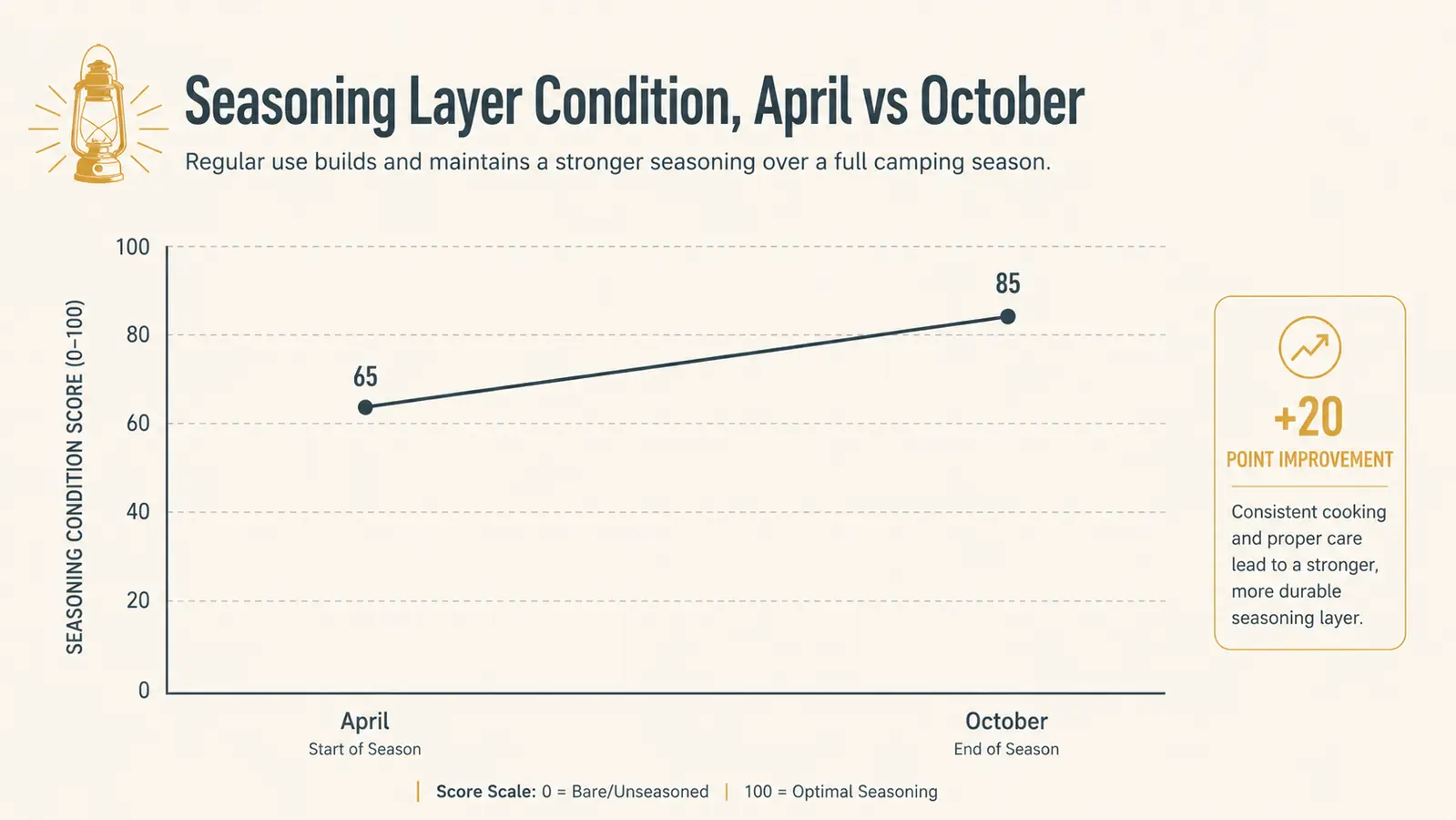
Beyond that, care is simple and cheaper than people expect. No soap, just hot water and a stiff brush or a chainmail scrubber for stuck-on food, dry it completely, oil it lightly, done. By October the seasoning on the inside was darker and more slick than it was in April, which is the opposite of wear, cast iron gets better with use if you take care of it, it doesn't wear out the way a nonstick coating does.
The Gear You Actually Need Alongside It
I'll say this plainly because I've watched people get burned learning it the hard way: leather gloves and a proper lid lifter are not accessories for this oven, they are necessities. A cast iron dutch oven sitting in coals gets hot enough on every surface, legs, handle, lid, that bare hands or a thin kitchen towel are not enough protection. I use a pair of long leather welding-style gloves I keep in the truck specifically for cooking, and a steel lid lifter, a hooked tool built to catch the flanged lid's handle and let you lift a coal-covered lid straight up without tipping ash into the food or burning your forearm reaching over the top.
I watched a camper on my loop try to lift a hot lid off one of these ovens with a folded bandana one night, and it went about as well as you'd guess, a dropped lid, spilled coals near a tent pad, and a burned hand that needed the first aid kit I kept at the host site. That's not a rare story with cast iron camp cooking. Budget for the gloves and the lid lifter when you buy the oven, not after you've already been burned.
What I Liked
- Three legs and flanged lid genuinely allow even, oven-style baking on coals, not just simmering
- Pre-seasoned out of the box, cooked well within the first week of use
- Holds heat evenly enough to tolerate being left unattended for short stretches without scorching
- Seasoning improved rather than degraded across a full season of regular use
- Built to last decades if kept dry between trips, a genuine lifetime piece of cookware
Where It Falls Short
- Heavy, close to 20 pounds bare and more with the lid, tiring to haul from a truck bed to the fire ring repeatedly
- Rusts if packed away damp, requires a real drying and oiling routine after every trip
- Not appropriate for backpacking, canoe trips, or any camping where you're carrying gear on foot any real distance
- Requires leather gloves and a lid lifter as necessities, not optional extras, adding to the total cost
I have watched thin pots scorch dinner on one side of the fire while the other side stayed cold. This oven never did that once in a full season, and that's the only review that matters to me anymore.
Who This Is For
This oven is built for car campers and campground campers who cook real meals at their site rather than just boiling water for freeze-dried food. It's a strong fit for anyone who wants to bake at a campsite, cobbler, biscuits, cornbread, not just simmer a one-pot meal, and for campers who stay put for several days or a full week at a time, the way I did hosting on Loop B, where the weight of the oven stops mattering because it isn't going anywhere between meals. If you're already invested in cast iron at home and want the same reliability outdoors, this is the natural extension of that.
Who Should Skip It
If you're backpacking, canoe camping, or working with limited trunk space in a compact car, this isn't your dutch oven. The weight that makes it durable also makes it a poor fit for anyone hauling gear on foot. I'd also skip it if you're not willing to dry and oil it after every single use, because a camper who lets cast iron sit damp is the camper I've watched lose one to rust within a season. For a more blunt breakdown of the tradeoffs, including a couple of frustrations I didn't cover here, I wrote an honest review covering what nobody tells you about camp dutch ovens before you buy.
Ready to stop scorching dinner over the fire ring?
After a full season cooking on coals, the Lodge Cast Iron Camp Dutch Oven is the piece of cookware I'd buy again without hesitating. Check today's price on Amazon and see if it's in stock for your next trip.
Amazon Check Today's Price on Amazon →