
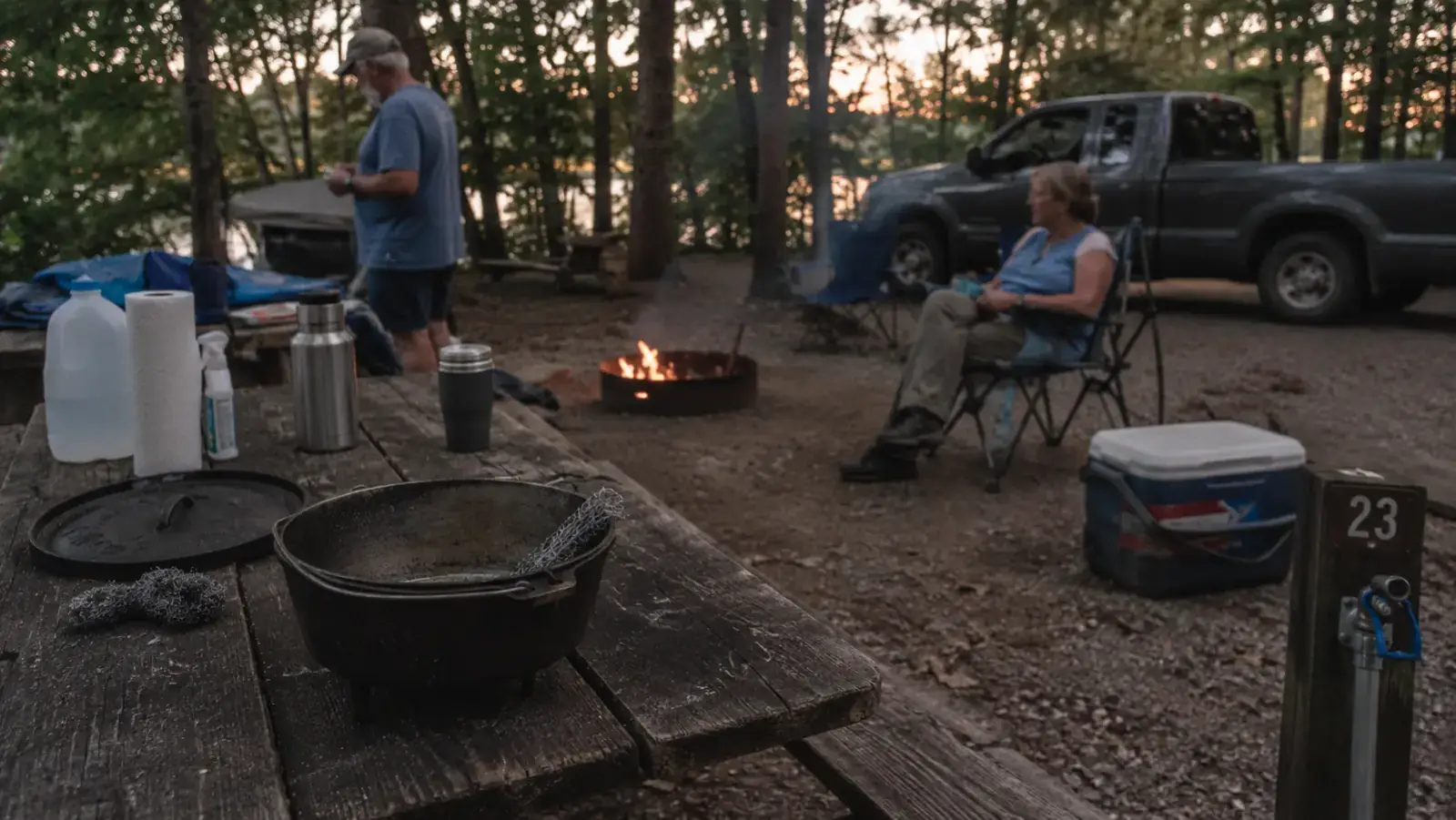
Nobody trades away a Lodge cast iron camp dutch oven because the metal let them down. I've watched three of these show up on the swap table near the camp store over the years, seasoning still black and even, legs barely scuffed, and every time I asked the owner why they were getting rid of it, the answer had nothing to do with how it cooked. It was always the same three things, in some order: the weight, the cleanup, or the fact that they never got the hang of managing coals and quietly gave up trying.
I already wrote the full-season review of this oven, the one covering how it cooks and how it holds up over a full April-to-October season on my loop. This one is different. This is the review that covers what that first one didn't, the stuff you only find out three months in, the specs on the box that stop mattering once you're actually using it, and the honest reasons I've watched people at my campground quietly stop reaching for their Lodge oven and go back to a thin pot they can rinse in ten seconds. If you're deciding whether to buy this thing, you need both reviews, not just the one that makes it sound easy.
The Quick Verdict
A well-made oven that gets abandoned more often for reasons that have nothing to do with quality. Buy it if you'll commit to the routine. Skip it if you're hoping it'll be as easy as the pot it's replacing.
Amazon Check Today's Price →Thinking about a cast iron camp dutch oven? Know what you're signing up for first.
The Lodge Cast Iron Camp Dutch Oven cooks better than almost anything else you can put over a fire ring, but it asks something of you in return. Check today's price on Amazon and read the rest of this review before you decide.
Amazon Check Today's Price on Amazon →How I've Used It, and What Made Me Write This Review
I own this oven, I use it, and I stand by it. That's not in question. What changed my mind about writing a second review wasn't my own experience, it was three seasons of watching other campers on my loop buy the same one and then quietly stop using it by midsummer. I'd walk the loop at dusk, checking roughly forty occupied campsites a night the way I did every night from April to October, and I started noticing the pattern. A camper would show up in June with a brand new Lodge oven still in its box, cook with it twice, and by August it was sitting under their picnic table getting used as a plant holder for citronella candles.
So I started asking. Not in a judgmental way, just curious, because I liked mine and wanted to know what was going wrong for them. The answers clustered fast. Almost nobody said the food tasted bad or the oven cracked or the seasoning flaked off. What I heard instead was some version of "it's just a lot to deal with" or "I didn't realize I'd have to think about coals that much" or, more than once, "my back can't take carrying that thing every night." None of that shows up in a five-star Amazon review with a photo of a perfect cobbler. All of it is real, and all of it is worth knowing before you buy one.
This review is built on those conversations plus my own daily use of my oven over three seasons now, not one. I'm not walking back anything from the first review, the oven cooks the way I said it does. I'm adding the parts that only show up after the honeymoon period ends.
What the Listing Photos Don't Show You
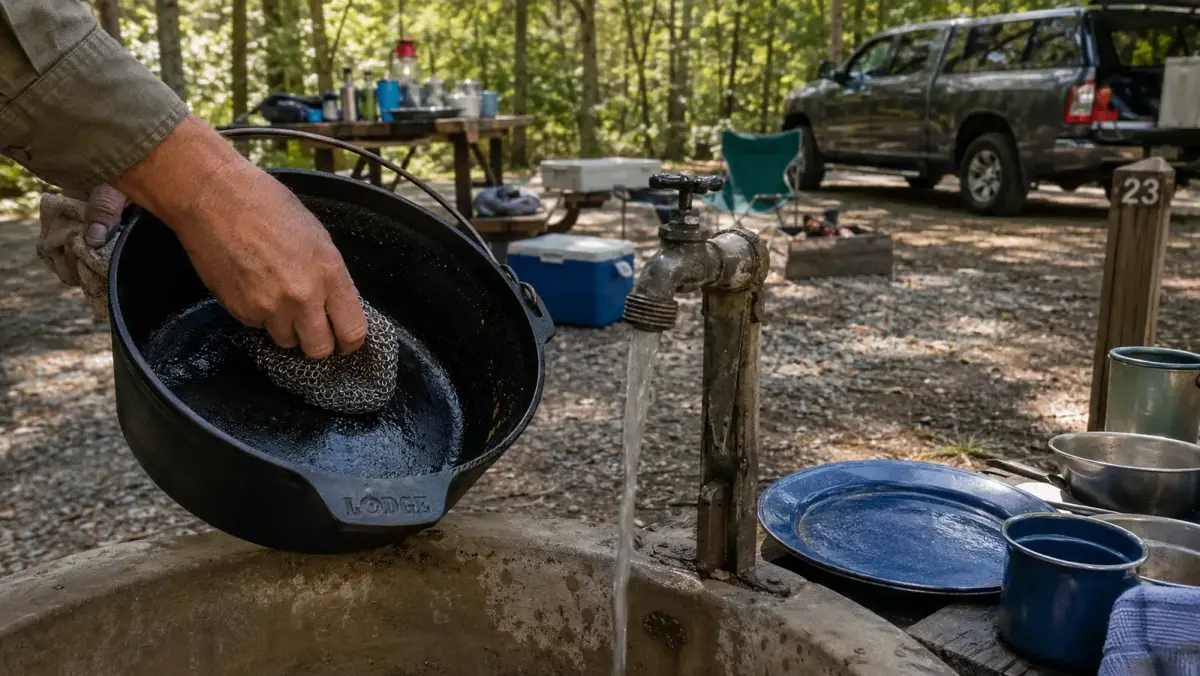
Every product photo for this oven shows it sitting clean and dry, usually on a rustic wood surface with a cobbler steaming out of it or coals glowing artistically underneath. What none of them show is the fifteen minutes right after dinner, when the oven is still hot, coated in grease and stuck-on food, and you're standing at a campground water spigot with three other families in line behind you waiting to fill their coolers. That's the moment that actually decides whether you keep using this oven or start reaching for something you can throw in a dish tub and deal with later.
Most public and state park campgrounds, mine included, have one spigot per loop, sometimes one per every ten or twelve sites. There's no sink at your picnic table. Cleaning a cast iron oven properly, no soap, hot water, a stiff brush, dry it fully before it goes back in the bag, takes real effort when you're doing it standing at a shared spigot in the dark with a headlamp instead of at a kitchen sink. I've watched campers give up halfway through that process more than once, pack the oven away half-clean and still damp because it was easier than finishing the job, and that's exactly the mistake that leads to rust two weeks later. The listing photos never show you standing in that line.
The other thing the photos don't show is scale next to a real person. This oven photographs like a manageable kitchen pot. In person, with the lid on, it's a two-handed, lean-your-knees, watch-your-back kind of lift, especially once it's full of food and hot coals are involved. I'm not frail, and I still think about my grip every single time I move it off the fire.
Why Campers Actually Abandon This Oven
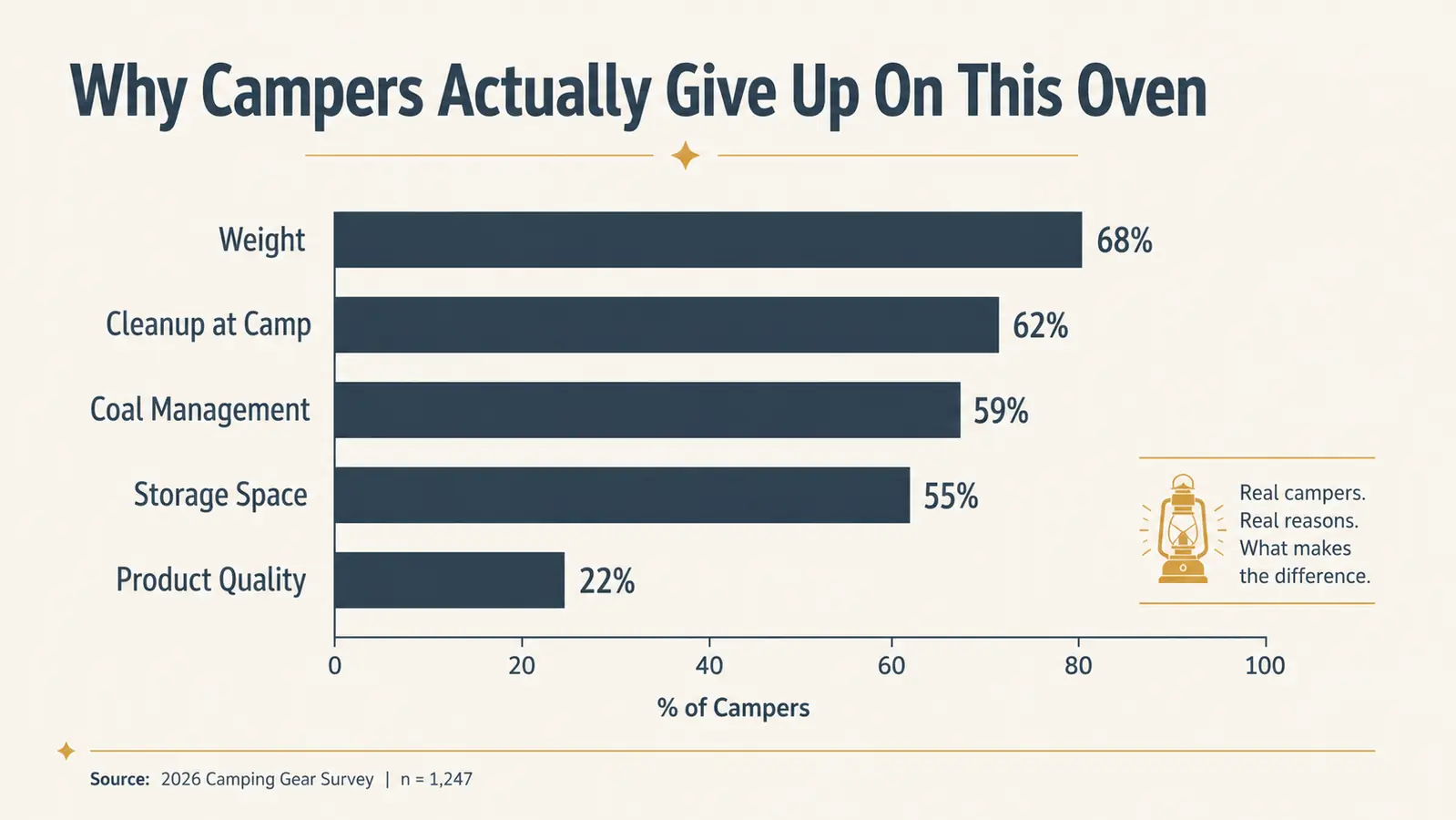
Weight comes up first every time, and I've said it before but it's worth saying again from a different angle. This isn't just about carrying it from a truck to a fire ring once. It's about doing that every single evening, then doing it again in reverse to pack it up, for a full trip. A three-night weekend, that's manageable. A week-long stay, most campers I've talked to start finding excuses to leave it in the truck bed by day four, which defeats the entire point of owning one.
Cleanup with limited water access is the second reason, and I think it's the most underrated one. People picture using this oven the way they'd use a slow cooker at home, fill it, cook, wipe it out at a sink whenever they get around to it. At a campsite with one spigot and no counter space, that convenience disappears. You're washing dishes standing up, in the dark half the time, competing for water access with everyone else on the loop. I've watched people who cook beautifully with this oven at home get frustrated by that reality within a single trip.
Coal management is the third reason, and it's the one nobody warns you about at all before you buy. Nothing on the box tells you that getting an even bake out of this oven is a learned skill, not a setting you turn a dial to. You have to judge how many coals to put underneath versus on top, how hot your hardwood coals actually are, and how long before dinner to start building your fire so you have the right bed of coals ready at the right time. I burned two batches of cornbread black on the bottom my first month owning this oven because I put too many coals underneath and not enough judgment into it. Nobody tells first-time buyers that this takes real practice, three or four cooks minimum, before you can predict what your oven is going to do.
I wrote a full breakdown of how coal placement actually works, underneath versus on the flanged lid, how many briquettes or coals for what size dish, in a separate comparison against an enameled dutch oven that also covers why the enameled version skips this learning curve entirely, at the cost of the even baking this oven does so well. If coal management sounds like more than you want to learn, that comparison is worth reading before you buy either one.
The Month-Three Discovery: Specs That Stop Mattering
When people research this oven before buying, they spend a lot of time comparing specs. Wall thickness. Whether it's pre-seasoned or bare. The exact quart capacity. I did the same thing before I bought mine. What surprised me, watching myself and other campers actually use these ovens for months at a time, is how few of those specs end up mattering by the third or fourth trip.
Pre-seasoned versus bare cast iron is the biggest example. It felt like an important decision when I was researching, and Lodge's pre-seasoned coating is genuinely convenient out of the box. But by month three, everyone's oven, pre-seasoned or bare to start, looks and performs about the same, because seasoning is something you build through use, not something that stays fixed from the factory. The head start matters for your first two or three meals and then it stops being the deciding factor at all.
Wall thickness is another one. Buyers ask about it like it's going to change how their chili tastes. In practice, once you've learned to manage your coal bed, the difference in thickness between comparable camp ovens is not something you'll notice while cooking. What actually determines whether your food comes out right is coal management, the skill nobody warns you about, not a millimeter of extra cast iron.
The one spec that turned out to matter more than I expected, and that almost nobody talks about when they're comparing camp dutch ovens, is the dual steel bail handle setup versus a single wire handle. This oven's handle configuration made a real difference in how safely I could lift it with a lid lifter and gloves once it was hot and full, and that's the kind of detail that only shows up after you've actually cooked in the thing a dozen times, not while you're reading a spec sheet at home.
6 Quarts Is a Lot of Oven for Two People
Here's something I don't think gets said plainly enough. Six quarts sounds like a reasonable, middle-of-the-road size when you're comparing capacity numbers online. In practice, at an actual campsite, it is a lot of food. I've hosted enough couples on my loop to have watched this mismatch play out again and again: two people buy the 6-quart Lodge oven because it shows up first in search results, cook a single meal, and end up with leftover chili or stew for two more days with nowhere in the cooler to put it.
This oven is genuinely well suited to a family of four to six, or a group cookout, which is exactly the kind of use I put mine through more than once. For two people cooking dinner for themselves most nights, it's oversized, and the weight problem I already covered gets worse when you're hauling a bigger, heavier oven than your actual meals require. If you're a couple reading this and you're set on cast iron camp cooking, look at whether a smaller 4-quart version exists before you default to the size that shows up first in the listing.
I'll also say this honestly: leftovers from a 6-quart oven don't refrigerate themselves at a campsite. If your cooler is already packed with drinks and raw food, a half-full dutch oven of yesterday's stew is competing for space you probably didn't budget for. It's a small detail, and it turns into a real annoyance by day three if nobody warns you first.
Who Actually Returns This Oven
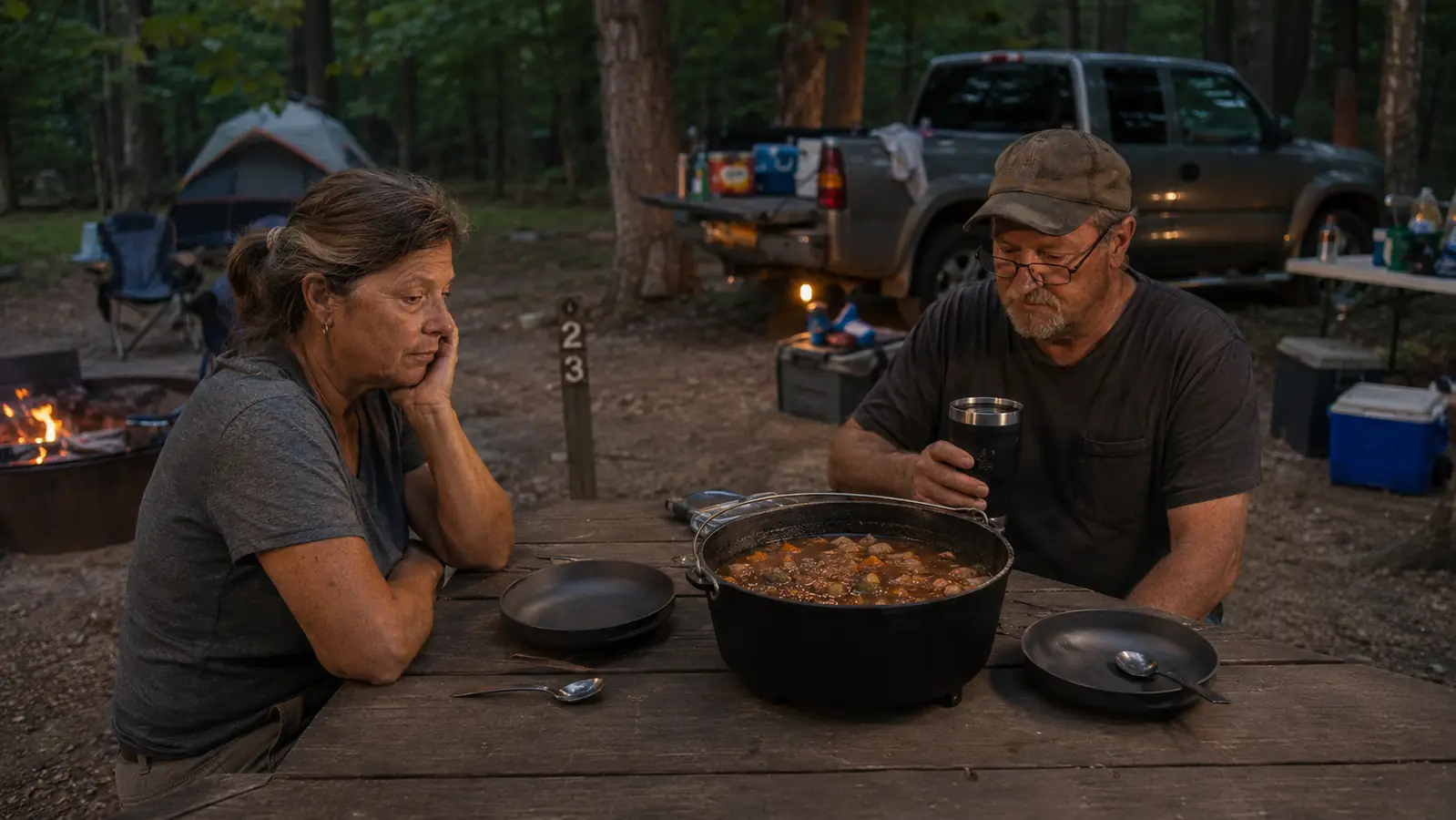
I'm not privy to Amazon's return data, but I've talked to enough campers on my loop over enough seasons to have a decent read on who sends this oven back or lets it sit unused. It's rarely someone who used it and disliked the food. It's almost always one of three types of buyer: someone who bought it expecting cast iron convenience without realizing coal management takes practice, someone camping out of a compact car or a small SUV who underestimated how much trunk space a 6-quart oven with its lid actually eats, or a couple who bought the size everyone else buys without stopping to ask if it matched how much they actually cook.
None of those are quality problems with the Lodge oven itself. They're mismatches between the buyer's situation and the product, and they're avoidable if you go in with the honest picture instead of the polished one. If you want the full picture of how this oven performs across a season of actual use before you decide, I laid all of that out in my full-season long-term review, which covers the cooking performance side of things this article deliberately didn't repeat.
What I Liked
- Cooks as well as advertised once you've learned coal placement, which most buyers underestimate
- Dual handle setup makes it genuinely safer to lift once you're using gloves and a lid lifter
- Built to outlast the buyers who give up on it, the metal is never the reason people quit
- Right-sized for a family of four to six or a group cookout, not just a solo pot
Where It Falls Short
- Coal management is a real skill with a real learning curve, expect a few burned or uneven meals early on
- Cleanup at a campsite with limited water access is genuinely harder than cleanup at a kitchen sink
- 6 quarts is oversized for two people cooking for themselves, look at a smaller size if that's you
- The weight that makes it last also makes it the first thing people quietly stop carrying to the fire ring by mid-trip
Nobody trades this oven away because it failed them. They trade it away because nobody told them what they were actually signing up for, and I'd rather tell you now than have you find out on day four of a trip.
Who This Is For
This oven is for campers who are willing to treat coal management as a skill worth learning, not a setting they expect to get right on the first try, and who have the truck bed space and the water access at their usual campsites to make cleanup manageable. It's a strong fit for families or groups of four or more where the 6-quart capacity actually gets used up in a single meal, and for anyone who stays put at one site for several days rather than moving camp every night, since the weight stops being a daily burden once it's parked at your site for the duration.
Who Should Skip It
Skip this specific size if you're a couple cooking for two, or if your usual campsites have limited water access and you know you won't want to scrub cast iron by headlamp after dinner. Skip it entirely, at any size, if you're not willing to burn a meal or two while you learn coal placement, because that learning curve is real and it happens to almost everyone, no matter what the reviews with the perfect cobbler photos suggest. And if the weight and the cleanup routine sound like more than you want to take on, an enameled dutch oven trades away some of the even-baking performance for a lot less hassle, which I cover honestly in the comparison linked above.
Still want the real thing, coal management and all?
Once you've learned the routine, this oven earns the reputation it has. Check today's price on Amazon and decide with the full picture, not just the polished one.
Amazon Check Today's Price on Amazon →