
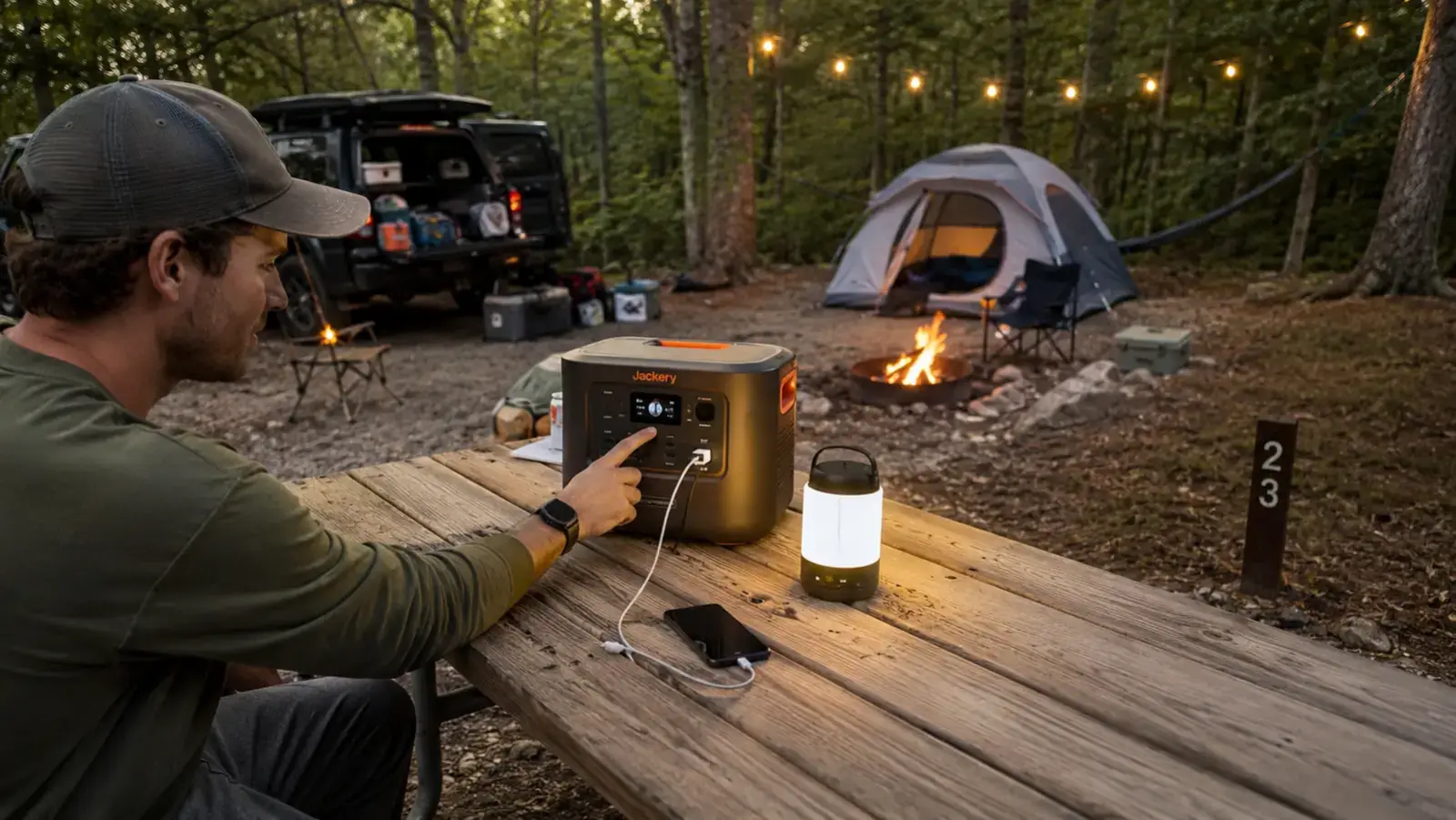
By my third season hosting at the park, I'd stopped being surprised by how much power a modern campsite pulls. Loop B had no electrical hookups, thirty amp or otherwise, just gravel pads and fire rings, and most nights when I walked the loop at dusk checking roughly forty occupied campsites, I'd see the same thing: a family huddled around a single 12-volt car charger, arguing over whose phone got plugged in next, while a lantern died halfway through dinner. Nobody plans their power budget until they're standing in the dark realizing they should have.
A portable power station fixes that, but only if you buy one sized for what you're actually going to plug into it. I've watched campers show up with a Jackery Explorer 300, a battery about the size of a large toaster with 293 watt-hours of capacity, expecting it to run a mini fridge for a week plus a laptop plus four phones plus a coffee maker, and then wonder why it's dead by night two. The unit isn't the problem in that story. Nobody did the math first. This guide is that math, worked out in real numbers, so you know before your trip whether 293 watt-hours covers what your camp actually needs, or whether you need a recharge plan, a solar panel, or a bigger unit.
Tired of guessing whether your power bank will make it through the weekend?
The Jackery Explorer 300 packs 293 watt-hours into a battery that fits behind a truck seat, enough to run phones, lanterns, and small electronics through most weekend trips without pulling a single amp from your vehicle. Check today's price on Amazon before you pack.
Amazon Check Today's Price on Amazon →Step 1: List Every Device You Actually Plan to Charge, in Watt-Hours
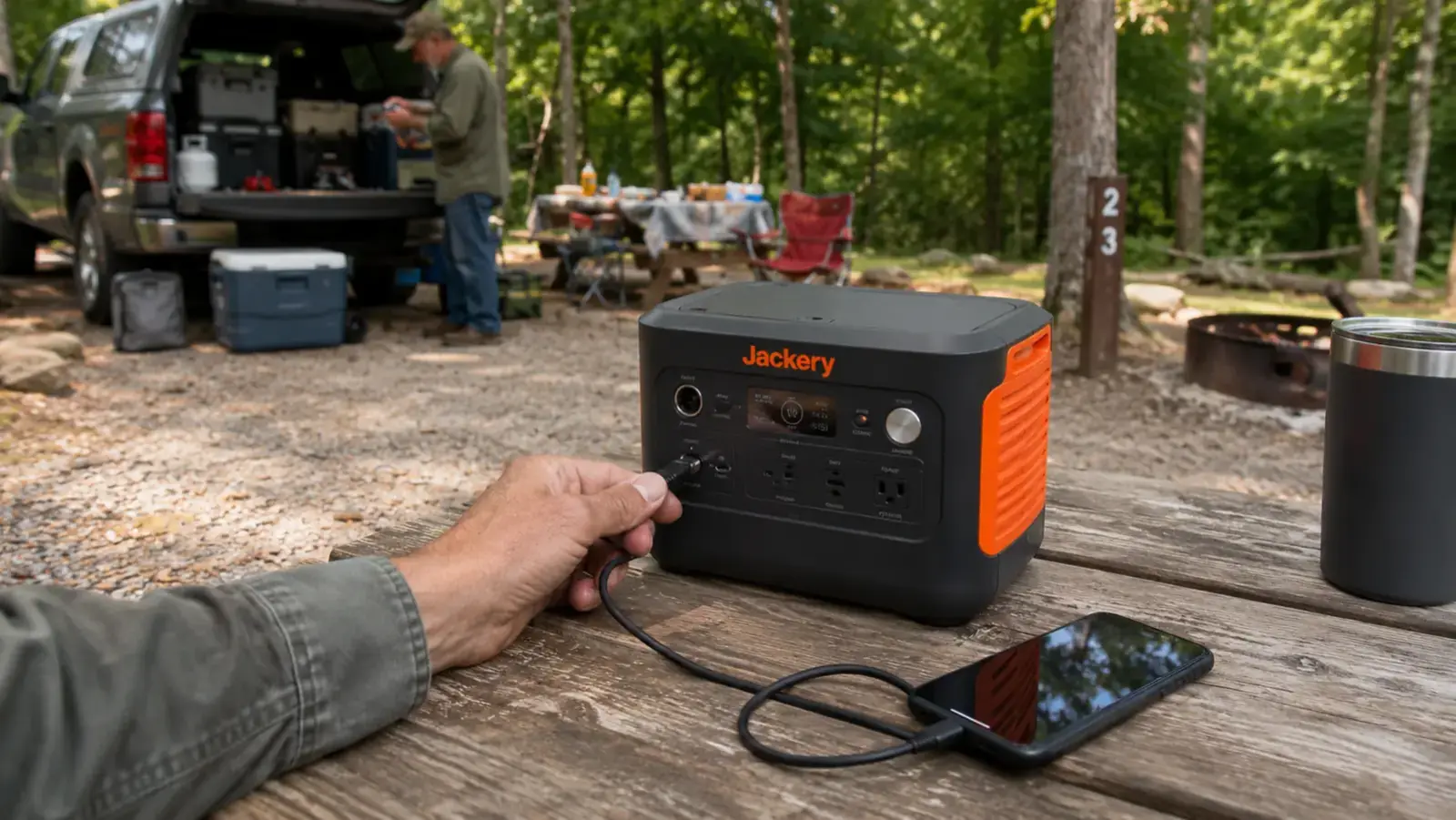
Every device pulls power at a rate, measured in watts, but what actually drains a battery is watt-hours, the rate multiplied by how long it runs. A phone charger might be rated at 20 watts, but it only draws that rate for the twenty or thirty minutes it takes to top off a mostly-charged phone, not for hours at a stretch. Confusing the two is the most common mistake I watched campers make on Loop B, buying a power station rated for more wattage than they'd ever need while running out of total capacity by the second night regardless.
Most electronics list their draw somewhere, even if you have to dig for it. A phone's battery capacity is usually printed in milliamp-hours, something like 3,500mAh, and you convert that to watt-hours by multiplying by the battery's voltage, usually 3.85 volts for a phone, and dividing by 1,000. That gives roughly 13.5 watt-hours for a full charge from zero, though in practice you're rarely starting from zero at a campsite. For anything with a battery, laptop, tablet, camera, headlamp, check the label or the manufacturer's spec sheet and write the watt-hour number down before you leave the driveway.
For devices that run continuously instead of charging up, like a lantern or a fan, multiply the wattage by the hours you'll actually run it. An LED lantern pulling 5 watts, run three hours a night, costs you 15 watt-hours a night, every night. Over a four or five night trip, that steady draw ends up mattering more than any single phone charge does.
A laptop is the device most campers get wrong. A typical laptop battery holds somewhere between 45 and 60 watt-hours, and unlike a phone, laptop chargers rarely support the fast USB-C charging that limits wasted heat, so I plan on 60 to 70 watt-hours for a full laptop charge once conversion loss is factored in. If you're bringing a laptop along for work calls or evening movies, that single device can eat close to a quarter of a 293 watt-hour battery in one sitting, so weigh whether you actually need it before you build the rest of your budget around it.
Step 2: Add Up What One Full Day at Camp Actually Costs You
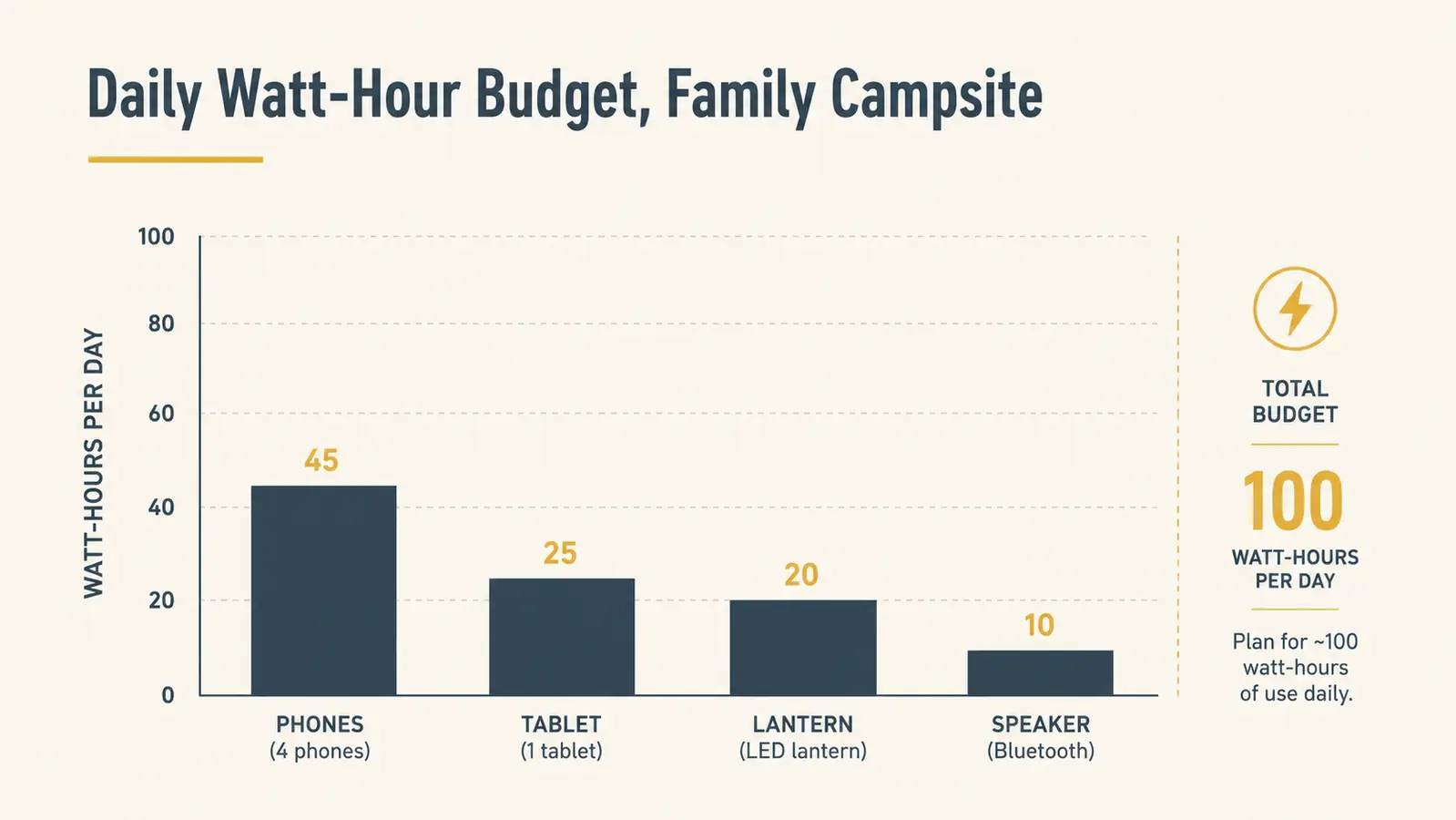
Here's a real budget I'd give a family of four heading out for a long weekend. Four smartphones, topped off once a day rather than charged from empty, run about 12 watt-hours each, 48 watt-hours total. A tablet for the kids, charged every other day, averages out to roughly 13 watt-hours a day. A rechargeable LED lantern at the picnic table, run three hours a night, is another 15 watt-hours. A Bluetooth speaker at the fire ring, run a couple hours every other night, averages 16 watt-hours a day. Add a camera battery top-off at 3 watt-hours a day and you land at 95 watt-hours, call it 100, for one ordinary day at a busy family campsite.
That number is the one that matters, not the battery's total capacity printed on the box. A 293 watt-hour power station sounds enormous until you realize a busy family site can burn through a third of it in a single day.
Step 3: Multiply by the Nights You'll Actually Be Off Grid
Multiply that daily number by how many nights you'll go without a recharge option, then knock the power station's usable capacity down by 10 to 15 percent to account for conversion loss between the battery and whatever's plugging into it. A Jackery Explorer 300 rated at 293 watt-hours realistically gives you something closer to 250 usable watt-hours once you account for that loss. For the family I just described, running 100 watt-hours a day, four nights off grid means 400 watt-hours of real demand against roughly 250 watt-hours of usable capacity. That family runs out of power by the end of night two, full stop, no matter how good the unit is.
I always build in a safety margin of about 20 percent on top of that loss calculation, because campsite plans rarely go exactly as scheduled. A rained-out afternoon that keeps everyone in the tent running a phone for movies, or a fishing trip that runs long enough for headlamps to come out early, both push your real number above what a clean spreadsheet predicts. Budget for the trip you might actually have, not just the one you planned on paper.
Now run the same math for a couple camping a two-night weekend with two phones, one lantern, and a camera. That's closer to 40 watt-hours a day, 80 watt-hours across the whole trip. That same 293 watt-hour unit finishes the weekend with over 150 watt-hours to spare, enough room to add a laptop charge or run a fan on a hot night without thinking twice. Same power station, two completely different verdicts, because the math is about your trip, not the number printed on the battery.
Step 4: Build a Recharge Plan Before You Ever Leave the Driveway
If your math comes out short the way that family's did, you have three honest options, and I'd rather you pick one on purpose than find out at the campsite. The first is recharging along the way. A power station like the Explorer 300 will take a charge from a truck's 12-volt outlet while you're driving between towns or running to the camp store, and that's a genuinely useful way to top off. But that only applies while the vehicle is moving or parked out in the open. Never run an engine in an enclosed garage, a closed vestibule, or any space that traps exhaust just to charge a battery. That's not worth the risk for a phone charger, and it never will be.
The second option is a campground outlet, if your site has one. A lot of state and county parks, mine included, wired at least a portion of the loop for standard electrical hookups. If you're booking a site, check whether it has power before you assume you're fully off grid, because that single fact changes the whole math you just did.
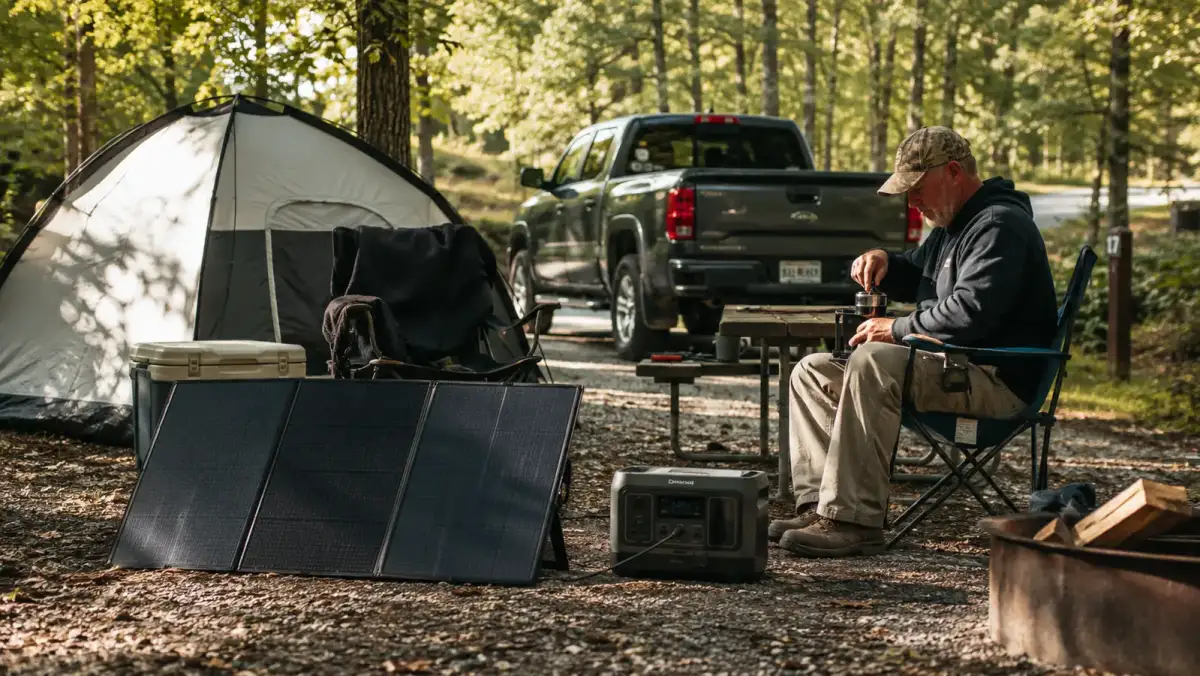
The third is the optional solar panel that pairs with units like the Explorer 300. It won't fully refill a drained battery in one sunny afternoon, but a few hours of good sun can realistically add 60 to 100 watt-hours back, which is often enough to turn a tight four-night trip into a comfortable one. I go deeper into how the Jackery actually performs across a full trip, solar panel included, in my full long-term review of the Explorer 300.
Step 5: Decide Honestly Whether 293 Watt-Hours Is Enough for Your Trip
Here's the honest breakdown after watching hundreds of families run their gear across a full season. If you're a solo camper or a couple with phones, a headlamp, and maybe a speaker, a 293 watt-hour unit like the Jackery Explorer 300 will comfortably carry you through most weekend and even week-long trips, especially with a recharge option built in. If you're a family of four running phones, a tablet, a lantern, and a speaker every day, plan on recharging every second night at minimum, or budget for a bigger unit if your site has no outlet and no sun for solar.
One device changes this math more than any other: a CPAP machine. A basic CPAP without a heated humidifier draws somewhere around 30 to 40 watt-hours a night on its own, before anyone charges a single phone. If you or someone in your camp uses one, do that math separately and add it to everything else, because it can eat close to half a night's usable capacity by itself. For a lot of CPAP users, the honest answer is a larger power station, not this one, or a firm recharge plan every single day of the trip. I'd rather tell you that now than have you find that out at 2am on night three.
What Else Helps
A few habits stretch whatever capacity you have, no matter which power station you buy. Charge through a USB-C port instead of the AC inverter outlet whenever the device supports it. The inverter has to convert battery power to household AC and then the charger converts it back down again for most devices, and that extra conversion wastes energy as heat. A direct USB-C connection skips that step and measurably stretches how many total charges you get out of a trip. Unplug devices once they hit full instead of leaving them topped off overnight, and switch the unit's display or inverter off between uses instead of leaving it idling, since even an idle inverter pulls a small continuous draw that adds up over a four or five night trip. When you're deciding what to bring at all, a battery-powered or hand crank lantern for backup nights costs the power station nothing, which is exactly the kind of small swap that turns a tight power budget into a comfortable one. My list of what a power station is actually worth carrying for covers a few more of these tradeoffs if you're still deciding what earns a spot in the truck.
It's also worth knowing how the battery itself is rated to age, since that changes how much this math matters year to year. Lithium iron phosphate batteries, the chemistry inside the Explorer 300, are typically rated for around 3,000 charge cycles before capacity drops below 80 percent of new. For most camping households, that works out to a decade or more of regular trips before the numbers in this article start to shift on you, which is a lot better than the cheaper lithium-ion power banks I've watched campers replace every couple seasons.
I've watched a lot of families do this math the hard way, standing in the dark on night three with a dead phone and no plan. The ones who never had that problem did the arithmetic before they left the driveway, not after.
Ready to stop rationing your phone charger by night two?
Work out your own numbers, then check whether the Jackery Explorer 300 covers your trip. At 293 watt-hours it's enough for most weekend and solo trips, and it pairs with an optional solar panel for longer ones. Check today's price on Amazon before you head out.
Amazon Check Today's Price on Amazon →